
If a pet becomes a witch


What would you do if a cat, bat or rat that had been terrorizing you at night with blood-curdling cries and strange noises finally got caught in your trap?

You approach it, ready to deal with the troublesome creature, and suddenly it cries out in a human voice, “Please don’t kill me. Have mercy!”

What would you do then?

A cat had been visiting the dormitory of the orphaned children at Dreamland at night. The children became convinced that this was no ordinary cat. They prayed for its visits to end and eagerly looked forward to the day it would finally be caught.

After several unsuccessful attempts, one night they trapped it.

They killed the cat and burned its remains.

The children celebrated almost throughout the night. As far as they were concerned, the creature that had terrorized them was gone. They believed the cat was associated with witchcraft, and its death represented a spiritual victory.

But their celebration raised some difficult questions.

If it really had been a witch, that is, if their understanding was that a human being had somehow taken the form of a cat, should they have killed it, believing that somewhere a human being might consequently die?

On the other hand, what if it was simply a cat?

Animals that are regarded with suspicion in one culture are loved as pets in another. Could this have been somebody’s pet scavenging for food at night? Could it have been a stray animal simply looking for food, warmth or shelter?

These were some of the questions that troubled my Western missionary friends when they heard the children’s story.

When Two Worlds Meet
And this is where missionary work becomes interesting.

In cultures where certain animals are traditionally regarded as spiritually significant, whether evil, sacred or mysterious, a missionary can easily misunderstand the people he has come to serve.

We bring more than the Gospel when we cross cultures.

We bring our upbringing.

Our assumptions.

Our fears.

Our education.

Our ideas about what is rational and irrational.

And unless we are careful, we may confuse our cultural worldview with biblical truth.

This is where contextualization becomes important.

Contextualization is not changing the Gospel to make it acceptable. It is learning how to communicate the unchanging Gospel faithfully within the worldview of the people receiving it.

The Gospel itself may offend. But we, its messengers, should not create unnecessary offence through cultural arrogance.

We must clothe ourselves with humility and love, patiently learn from the host culture, and prayerfully search for the pathways God has already prepared within that culture through which the Gospel can enter.

But What About the Spirit World?Scripture does not ask Christians to pretend that the spiritual world does not exist. The Bible speaks openly about witchcraft, sorcery, deceptive spirits and spiritual powers.

But acknowledging spiritual realities does not mean that every strange animal, unexplained sound or frightening occurrence should automatically be labelled demonic.

That creates another danger.

The real question, therefore, is one of discernment. How do you differentiate between an ordinary cat behaving like a cat and something you believe has spiritual significance?

When is something real, imagined or misunderstood?

When should a missionary challenge a cultural interpretation, and when should he first sit down, listen and try to understand what lies behind it?

These are not always easy questions.

And quick answers are often dangerous.

Things Are Not Always What They Seem
In the movie The Matrix, Neo eventually discovers that things are not what they appear to be. The world he has accepted as reality is actually an elaborate illusion. He needs an awakening.

In a very different sense, Scripture also reminds us that there is more to reality than what our physical eyes can perceive.

Yet Christians are not called to live suspicious of everything around them. Neither are we called to dismiss everything we cannot explain.

We are called to discern.

Among the gifts of the Holy Spirit listed by Paul is the “discerning of spirits” (1 Corinthians 12:10). That gift reminds us that spiritual matters require dependence upon God rather than fear, superstition or mere human reasoning.

So when my missionary friends wrestled with the story of the Dreamland children and their mysterious cat, I understood their discomfort.

I grew up with pets. I love animals. We have two dogs here ourselves.

But I also understood something my friends initially struggled to appreciate. For those children, this was about much more than a cat.

For nights, they had lived with fear. They had prayed. They believed something was terrorizing them. And when the nightly disturbance finally ended, they interpreted that moment through the spiritual worldview in which they had been raised.

Their overwhelming emotion was not cruelty.

It was relief.

It was victory.

And, rightly or wrongly in their interpretation of what the animal represented, the experience strengthened their confidence that God heard their prayers.

That is the part a cross-cultural missionary must not dismiss too quickly.

Our responsibility is neither to validate every traditional spiritual explanation nor to ridicule what we do not understand. Rather, we must patiently bring every belief, fear and experience under the light of Scripture while helping people grow from fear and superstition into mature faith in Jesus Christ.

Perhaps, then, the biggest question raised by the Dreamland cat is not:

“Was that cat really a witch?”

Perhaps the more important missionary question is, “How do we help people interpret frightening and unexplained experiences through Scripture without despising their culture, or reinforcing their fears?”

That requires more than logic.

It requires humility.

It requires Scripture.

And it requires discernment.

May Abba Father give us wisdom to recognize truth, courage to confront darkness, and landmark testimonies of His faithfulness that deepen our confidence in Jesus Christ.

Visitors from the underworld Pt 2 of 2

When Anne left Juba for Yei, she said she had been given an eight-day “holiday” by the spirits she believed controlled her life. But when she arrived in Yei, her family insisted that she must not return to Juba.


Her family knew nothing about the strange world Anne said she had become involved with. But according to her, their decision greatly angered her “spirit husband” and the other beings associated with him.

Soon, she said, the spirits began visiting her in Yei and oppressing members of her family. Then came an ultimatum: she must return to Juba by November 4, 2011.

An Unexpected Intervention
Around this time, a brother in our church had a vision in which he saw Anne and two other young women in great danger. He shared it with me, and I encouraged him to prayerfully visit Anne and share the Gospel of Jesus with her.

He did, and returned with a disturbing story of his own.

While ministering to Anne that evening, he found himself overwhelmed by sexual temptation toward her. Anne then confronted him with what she said the spirits were telling her—“This preacher is weak.”

Shaken, the brother admitted that while trying to minister to her, his own mind had become polluted with lust.

The encounter deeply unsettled him. He asked us to pray for his protection and for his family. But I encouraged him not to retreat in fear. I asked him to return and bring Anne to us.

He did.

And our first ministry session with Anne began.

Exposing the Lies
Anne tried to keep her story brief, but from her responses, expressions and gestures, it was obvious that she was deeply confused and afraid. As we listened, we began walking her through several biblical truths.

First, we explained that the beings she described were not friends sent to help her.

From our understanding of Scripture, we told her that deceptive spirits are fallen beings, enemies of God whose purpose is not to give life but to deceive and destroy.

Anne immediately responded that these spirits had repeatedly told her that God was wicked and wanted to destroy her life.

Because of what they had told her, she had stopped praying and had not entered a church since these encounters began.

We showed her from Scripture that deception is one of Satan’s oldest weapons and that Satan himself can masquerade as an “angel of light” (2 Corinthians 11:14).

Slowly, she began to recognize the contradiction, beings who appeared beautiful and offered prosperity had also filled her life with fear, bondage and hostility toward God.

Second, we talked about her sudden prosperity.

Anne believed that these spirits had somehow been connected to the extraordinary growth of her business. We took her to Matthew 4:8–9, where Satan offered Jesus the kingdoms of the world in exchange for worship.

Anne then told us something disturbing. She believed many young people were being drawn into similar spiritual bondage through their desperate pursuit of wealth. She also claimed to know other young women in Yei whom she encountered on “the other side.”

But now the questions began pouring out of her:

“Why me?”

“How did they make me disappear and reappear on this side?”

“Why do these spirits hate God so much?”

“Why are they afraid of Jesus and praying people?”

And perhaps the most important question:

“Can God still forgive me and prosper me?”

Those questions opened the door for us to present the Gospel.

The Greater Deception
Third, we explained that Scripture presents rebellious spiritual powers as already condemned (Matthew 25:41).

Anne believed this. She told us that these beings had tormented her repeatedly and threatened her life several times.

Then we came to perhaps the most difficult part of the conversation—her son.

Anne maintained that her son had died and had been buried. Yet she also insisted that whenever she went to “the other side,” she saw him there.

We told her plainly: if her son had truly died and been buried, then whatever she was encountering and identifying as her son could not simply be assumed to be the child she had buried. We believed she was being deceived by something presenting itself in a familiar form.

This troubled her deeply.

“But he is growing,” she insisted. “He is growing like other children. How can he not be my son?”

We could not explain every detail of what Anne believed she had experienced. To her, these encounters were vivid and real. But we did not need to understand every mystery before pointing her toward the One we believed could set her free.

Then She Encountered a Different Kind of Love

This became the turning point. We presented to Anne a clear picture of the love of God.

The Gospel rests upon this extraordinary truth: God loved us while we were still sinners (Romans 5:8).

Anne began to see the contrast. The “spirit husband” she described was possessive. He controlled her. He threatened her. He claimed her body and demanded her loyalty through fear.

Jesus was different. He wasn’t inviting her through terror but through love. He was calling her away from bondage and toward Himself.

The contrast became unmistakable.

The grip that this other world appeared to have upon her began to loosen as she encountered the gentle, saving love of Jesus Christ.

Finally, Anne said she wanted Him, and we began to pray.

Jehovah, the Man of War
After hours of ministering to this young woman, we witnessed what we understood to be a remarkable work of God in her life.

There was prayer.

There was confession.

There was renunciation.

There was resistance.

And, eventually, there was peace.

We remembered the words of Moses, “The LORD is a man of war: the LORD is his name.” Exodus 15:3

Anne confessed Christ, renounced the spiritual relationships that had held her in fear, and emerged from that long session with a freedom and peace we had not seen in her when she arrived.

But we know that one dramatic encounter is not the end of discipleship.

It is the beginning.

We have therefore started a special daily discipleship journey with Anne. She needs to become deeply rooted in Scripture, grow in her understanding of who she is in Christ, learn to recognize truth from deception, and become established within the community of believers.

Please pray for Anne.

Pray that Abba Father will perfect the work He has begun in her. Pray that she will become firmly established in Christ and that fear will no longer rule her life. Pray also that her testimony will become an instrument through which others living under similar fear and bondage can encounter the freedom of Jesus.

And please pray for us as we minister in this environment, that God will give us wisdom, discernment, humility and courage, and strengthen us with might by His Spirit.

For ultimately, this story is not about the power of darkness., it is about the greater power, mercy and love of Jesus Christ. Hallelujah!

Visitors from the underworld Pt 1 of 2

I was quite surprised, on returning here in Yei—South Sudan, to witness and hear reports of what appears to be an increase in disturbing spiritual activity since my last visit. Stories abound, from alleged demonic abductions of adults and women reporting sexual assaults by mysterious giant men, to troubling patterns of sexual seduction among teenagers. Some days, you simply do not know what you will hear next.

Barely 48 hours after I arrived, my phone rang. One of my disciples urgently needed me to come and help with a deliverance situation. It was already 9:30p.m. A young girl in his neighborhood was manifesting in a way those around her could neither understand nor handle.

We have encountered many situations like this before, in different forms, but the apparent increase has become a matter of serious concern.

Then came Anne.

Anne, not her real name, shared a story that left us with many questions. Before we prayed with her yesterday, she sat with me and two other brothers and recounted what she described as repeated encounters with visitors from another world.

Anne arrived in Yei a few weeks ago from Juba, where she had lived for about three years. Originally from Yambio, a growing town in southwestern South Sudan, she was then a single mother in her mid-to-late twenties.

Desperate to make a better life for herself, she moved around Juba looking for an opportunity. One day, she found five Sudanese pounds on the road. Instead of spending it, she invested it in roasting and selling fresh corn. According to her, by the end of that day she had made fifty-five Sudanese pounds.

The following day, she used the money to buy a carton of beer to resell. Business moved incredibly fast. She said she eventually sold nine cartons that same day. Before long, she had acquired a bar, and within weeks the business was booming.

It was a welcome breakthrough, but, in her telling, something strange soon followed.

One evening, she returned home to the single room she shared with her young son and found the entire room illuminated by a light whose source she could not identify. There were no shadows anywhere.

Terrified, she ran outside and called others to come and see it. They entered the room but saw nothing unusual. She alone could see the mysterious light.

Eventually, she gathered enough courage to remain in the room and lie down to sleep.

Then, she said, a huge, unusually tall white man appeared before her, his body glowing intensely. According to Anne, he reached for her son, and the boy died immediately. She was overwhelmed.

After her son’s burial, Anne said she began seeing the mysterious man more frequently. He told her that if she wanted to see her son again, she would have to follow him to what she called “the other side.”

She said she did.

And there, she claimed, she saw her son again.

She was warned that no one was to know what she had seen or heard.

According to Anne, these visits became increasingly frequent. In time, she said, one of the men there took her as his wife, and she had three children with him, two boys and a girl. She described this man, and others like him, as extremely jealous and possessive. He would not permit her to have sexual relations with another man.

She said this had continued for more than two years.

Anne also claimed that there were many children and adults on “the other side.” What particularly struck me was the way she described its beauty. Each time she spoke about it, there was a strange mixture of wonder and fear in her expression. She insisted that from her first encounter she knew this place was not of this world, even though life there seemed, in some ways, strangely familiar.

I asked her, “How do you get there?”

She motioned with her hands as though something were opening before her.

“They open the gates for you,” she said. “One of them walks in front and another behind. Then the gate opens and we enter.”

She paused before continuing.

“The chairs there are made of gold. There are so many beautiful things there, and beautiful people with spotless skin.”

We listened.

And then came the question that mattered most—How could Anne be set free from something that, according to her, had held her for more than two years?

That is where the next part of her story begins.

Read the concluding part tomorrow.

“The LORD shall go forth as a mighty man, he shall stir up jealousy like a man of war: he shall cry, yea, roar; he shall prevail against his enemies.”
—Isaiah 42:13


My last witchcraft encounter in Yei


You may not believe in the powers of witchcraft and occultism. I do, and the Bible is certainly not silent on the subject either.

Have you ever wondered how Pharaoh’s magicians turned their staffs into snakes in the presence of Moses? (Exodus 7:10–12)

During one of my mission trips to what is now South Sudan, I had one of the most frightening and unforgettable experiences of my missionary journey, and it happened on the very first night of my arrival.

I was exhausted after the long road journey from Kampala. I unpacked my things, spent some time with a handful of friends and disciples who had come to welcome me, and looked forward to a much-needed night of rest.

The weather was cool that night, and every part of me needed sleep.

But sometime around 1:30a.m., just as I was beginning to doze off, I heard something land heavily on the roof.

My first thought was that it must be a large bird. I knew I wasn’t dreaming.

Instinctively, I reached for my flashlight, only to remember that I had not taken it out of my luggage. Night birds, especially owls, were common around our area, and their annoying sounds could easily steal precious minutes of sleep.

But this felt different.

Whatever had landed above me sounded much bigger.

And something about it felt sinister.

I lay completely still, listening carefully and trying to identify it from the sounds it made.

Then the scuffling began.

Something, or perhaps more than one thing, seemed to be moving violently across the roof. I could hear what sounded like claws scratching against the roofing sheets, accompanied by heavy movements and repeated thumping.

It sounded like a fight.

From the force of the movements, I imagined these were large creatures. In my frightened estimation that night, they sounded heavy enough to weigh perhaps 40 kilograms or more.

The struggle continued for more than fifteen minutes. Though it felt like hours.

I generally live cautiously, but I am rarely given to panic. That night, however, I was terrified.

Then suddenly, whatever was struggling above me seemed to tumble from the roof, with a sound that suggested it slided off the metal sheet sharp ends by force and landed heavily on the ground beside my window.

And the wrestling continued.

Inside the safety of my well-netted bed, I began to pray. I spoke in tongues and quoted every Scripture that came to mind.

Then, just as suddenly as it had begun, everything stopped.

Silence.

An eerie, almost unnatural calm settled over the place. The crickets stopped chirping. The silence was like nothing I’ve even experienced all my years.

All I could hear was my heart pounding.

And then I heard a voice.

Clearly.

Audibly.

Words I have never forgotten, “They came for you. They want you, but I have you. Nothing will harm or hurt you here. You are Mine.”

I heard those words repeated five times. I closed my eyes so tightly I felt it hurting me.

What happened after that, I cannot fully explain. I do not remember when or how I eventually fell asleep.

Morning Came.

At dawn, I strang out of my bed and ran straight to the area beside the window where I had heard the creatures fall.

I expected to find something, perhaps a dead animal, a being of sorts, disturbed ground, footprints, scratches, anything that might explain what I had heard during the night.

There was nothing.

No animal.

No creature.

No footprints.

No obvious marks.

Nothing.

I spent longer than usual that morning praising and worshipping the Lord.

For the rest of that week, I lived with a strange mixture of emotions.

At times, I felt like an endangered species needing a government decree to protect me from poachers.

At other times, I felt like an invincible warrior, untouchable until my assignment was finished.

But beneath both feelings, one conviction became stronger—I was not alone.

There is tremendous courage in knowing that somewhere, people are praying for you.

Missionaries and those serving in difficult places should never underestimate the strength and encouragement that come from knowing that brothers, sisters, churches and partners are standing with them in prayer.

But there is something even greater than that, the unfailing promise of the presence, power and protection of Christ.

Our confidence is not that frightening things will never happen. Our confidence is that Jesus remains Lord when they do.

That assurance should not make us reckless. But neither should fear make us retreat from the assignment God has given us.

Jesus said, “All authority in heaven and on earth has been given to me. Therefore go and make disciples of all nations … And surely I am with you always, to the very end of the age. Matthew 28:18–20

Observe the order.

All authority is His.

Therefore, we go.

And as we go, He is with us.

That night in South Sudan, I understood those words in a way I had never understood them before, “They want you, but I have you. You are Mine.”

Casting out demons: What’s needed

Recently, while hanging around the lobby of a church in the United States during a tea break, I overheard two men discussing what appeared to be a topic from their ongoing discipleship class.

One of them said something like:

“Man, I can’t imagine this demon thing. You mean demons actually possess people for real?”

“I thought all that was Hollywood stuff. I can’t wait to see it for myself.”

“The thought of it really freaks me out.”

He was African American, and his apparent unfamiliarity with the subject got me thinking.

For a moment, I felt like interrupting, “Bro, add this to your list of ‘Things I Must Do Before I Turn 50, cast out a demon!”

I smiled at the thought, but behind the humor was a serious question:

How can Christians believe they have been given spiritual authority and yet go through life never learning how to exercise it?

You don’t need to become an expert in demonology before you can minister to someone experiencing what you believe to be demonic oppression. Neither does Scripture present deliverance as the exclusive ministry of a few spiritual specialists.

But I say that cautiously.

Some situations attributed to demonic activity are extremely complicated. They require maturity, discernment and wisdom. And not every disturbing behavior should automatically be labelled demonic; physical and mental health conditions must never be carelessly dismissed.

So what does someone ministering in such circumstances need?

You Need Courage
Let’s call it guts.

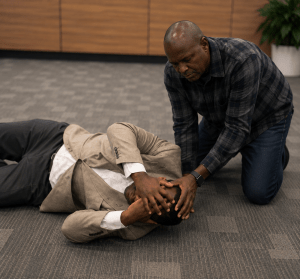
When someone is writhing uncontrollably on the floor, screaming in distress, speaking in strange voices completely different from theirs, or displaying other frightening behavior, you don’t casually walk into the situation as though nothing unusual is happening.

Unless, of course, you know you’re watching a staged performance.

But courage alone is dangerous. Our courage must be anchored in the knowledge of Scripture, an understanding of our spiritual authority in Christ, and wisdom about how that authority should be exercised.

You Need Jesus
Deliverance is not about shouting louder than a demon.

It is not about physical strength.

It is not about developing a frightening personality.

And it certainly isn’t about proving how spiritually powerful you are because our confidence is in Jesus Christ. The authority belongs to Him. The name belongs to Him. The victory belongs to Him.

Scripture says, “And these signs shall follow them that believe; In my name shall they cast out devils…” Mark 16:17 KJV

We cannot match the strength or cunning attributed to demonic powers through mere human ability. That’s what makes deliverance such a fascinating picture of the Kingdom of God.

God repeatedly works through what appears weak to demonstrate the superiority of His power.

Sheep among wolves.

The apparent underdogs carrying the authority of the King.

So, what’s the score? Jesus wins. Now and always!

But Authority Must Wear the Clothes of Love

Jesus told His disciples to be “wise as serpents and harmless as doves (Matthew 10:16).

That balance matters enormously in deliverance ministry.

The discerning of spirits is an invaluable spiritual gift (1 Corinthians 12:10), but discernment should never produce arrogance. And spiritual authority should never become an excuse for violence, humiliation or abuse.

At our last Students’ Conference in Yei, several young people experienced what we understood to be deliverance from demonic oppression.

What particularly encouraged me was that fellow students had already begun praying for some of them before the facilitators arrived.

Young believers were discovering that ministry wasn’t reserved for the people standing behind the pulpit.

But something else happened that concerned me.

At one point, someone attempted to become physical with one of those manifesting demonic possession in an effort to control the person.

That troubled me.

Over the years, I have seen people experiencing what their communities understood as demonic attacks being slapped, punched, beaten, restrained harshly or otherwise mistreated by people supposedly trying to “deliver” them.

At such moments, you begin wondering, Who exactly needs deliverance here?

We must never forget that the person in front of us is precisely that, a human, made in the image of God.

But also someone frightened, vulnerable, possibly confused and overwhelmed. Ultimately, someone Jesus loves.

If there is an evil spirit involved, our hostility should be channeled toward the evil spirit, not toward the human being who needs freedom.

Authority Without Compassion Is Dangerous

Perhaps this is where the conversation about deliverance needs to mature.

The question isn’t simply, “Can you cast out demons?”

There are deeper questions.

Can you exercise spiritual authority without humiliating the person you are trying to help?

Can you confront what you believe to be darkness while still treating the suffering person with dignity?

Can you minister boldly without becoming proud of your spiritual experiences?

Can you distinguish between something requiring prayer and something requiring medical or psychological attention, or recognize when both kinds of care may be needed?

And perhaps most importantly, Do you actually love the person you are trying to set free?

Ignorance of spiritual authority can be costly and fear can paralyze us. But possessing great confidence in deliverance ministry while lacking passion for God and compassion for people can be equally tragic.

Jesus did not give His disciples authority so they could become fascinated with demons. He gave them authority so captives could become free.

So perhaps the real question isn’t whether you’ve ever cast out a demon. The better question is, Are you learning to exercise whatever authority Christ has entrusted to you, with truth, wisdom, courage, grace and love?

What do you think?

Encounter with demons

Years ago, we derived immense satisfaction and, I must confess, even some excitement from engaging demons and dealing with them.

In those days, you dared not fall to the ground during one of our prayer or worship meetings! If you did, we were likely to interpret it as evidence of demonic activity, and you probably weren’t going home until whatever we believed was troubling you had been confronted.

We were young, zealous and sometimes overconfident.

Yes, Jesus warned His disciples not to become carried away because spirits submitted to them, but rather to rejoice that their names were written in heaven (Luke 10:20).

Still, there was something thrilling about the thought of little me confronting something supposedly bigger and stronger than myself, and seeing it submit to the authority of Jesus.

But don’t worry about me. My name had better be written in heaven!

Since arriving in Yei a couple of weeks ago, however, I have heard about and witnessed several situations attributed to demonic attacks. Some have involved children.

And it got me thinking.

Back home, encounters of this dramatic nature seem to have become less common, at least within the Christian circles familiar to me.

So, what happened? Did the demons flee?

Are the people in our neighborhoods suddenly free from spiritual oppression?

Have the demons somehow become immune to our prayers?

Or have we simply stopped recognizing their activities because they no longer look the way we expect them to look?

Could it even be that we are looking for dramatic manifestations while the enemy has become far more sophisticated, comfortably and quietly working among us?

That question took me back many years.

Fifteen Demons and a Fifteen-Year-Old Boy
In an earlier blog, Can Children Be Witches?Can Children Be Witches?, I promised to tell the story of one unforgettable encounter from my younger years.

Here it is.

In the company of two wonderful friends, I participated in what we understood to be the deliverance of a fifteen-year-old boy from fifteen demons.

It happened on the final night of an evangelistic outreach on a university campus. We called the meeting Holy Ghost Night and what a night it became!

The main meeting had ended, and most of the students had already left when I suddenly heard loud prayers coming from an unfinished building near the meeting hall.

Then came the repeated command, “Come out!” “Come out!”

I raced toward the sound. There on the floor was a young boy being physically restrained by several young men while Brother Austin Okeke, now a pastor, led the prayer session.

I watched for a few minutes.

When this young boy attempted to move his restrained limbs, the guys holding him down could hardly hold their ground. It was a war.

I became so fascinated by what was happening that I ran back to the hostel to get a tape recorder.

This encounter, I thought, must not go unrecorded.

By the time I returned, the team had cast out six of fifteen demons.

Brother Austin was using an approach we had not tried before. He asked each supposed spirit to identify itself and describe what it was doing in the boy’s life.

One after another, voices responded. I began recording when they reached the seventh.

The voice coming from the boy sounded to us like that of an old man and sometimes it came like an echo. He repeatedly gnashed his teeth in a manner that sent cold shivers down my spine.

For some time, he refused to answer our questions.

Then came these words, “When a foolish man holds his peace, he is counted a wise man.”

I was stunned.

About two weeks later, I came across those exact words in Proverbs 17:28 and it pained me much that the demon quoted a scripture and I didn’t know.

We continued asking for a name.

The boy’s face contorted strangely before the voice asked us, “Can you imagine a tree growing in the middle of the sea?”

Brother Austin tried to interpret the statement.

“So you are Oke Osisi?” he asked, an Igbo expression referring to a great tree.

No.

The answer, we were told, meant something more.

Then came the name, “Nkpologwu bi na mmiri.” In Igbo, roughly, “a root that dwells in the water.”

Each time the boy moved with such extraordinary force that the brothers restraining him lost their balance over and over.

The message being communicated was clear, “You cannot uproot me from this boy.”

But we continued praying, addressing the spirits tormenting this boy.

By now it was very late. We were getting tired.

Someone suggested that instead of continuing one by one, we should simply command all the remaining spirits to leave at once.

So we did.

There was only one problem:

Where were we sending them? To the Moon? The Sun? The Arctic? Everyone commanded them at will. The boy tossed and turned on the ground and let out a loud and prolonged scream. We believed he was delivered.

We were young and naive. Looking back today, I can smile at some of our youthful enthusiasm and theology.

Eventually, the boy opened his eyes. We celebrated and retired to sleep, assuming it was over.

But the following day, the boy approached Brother Austin and said something chilling, “How do you think you can cast all of us out like that?”

Apparently, as far as we understood the situation, it wasn’t over.

The Final Night
That Sunday evening, Brother Austin, Brother Ken Nwaopara and I took the boy to a quiet area of the campus to pray with him again.

This time, we approached things differently.

There was less physical restraint and less commotion.

We also kept asking ourselves one question, Why did this boy voluntarily come back?

Whatever was happening inside him, something within him seemed to want freedom.

We attributed that to the work of the Holy Spirit.

What followed remains one of the most extraordinary deliverance ministry experiences of my younger years.

The remaining demons each manifested in their unique voices and characteristics. They gave their names, described their supposed functions and made numerous claims about the boy, other people, local and national events.

Some things they said appeared to correspond with information we later encountered. Other claims concerned events and supposed spiritual schemes far beyond anything we could verify.

That experience taught us something important, but perhaps not exactly what we thought it taught us at the time.

We came away convinced that evil was more organized, deceptive and determined than we had previously imagined.

But today, years later, I think there was another lesson waiting for me.

What If the Enemy Doesn’t Need to Make You Scream?

When the last demon came out that night, the boy suddenly stood up and looked around.

“Why are we here?” he asked.

Then he noticed us sweating.

“What happened?”

We explained what we know had taken place.

He wept.

And there, that night, we led him to Jesus Christ.

I have never forgotten that encounter, but neither have I stopped thinking about it.

Because spiritual warfare doesn’t always look dramatic.

Perhaps this is where we sometimes get distracted.

We look for someone screaming on the floor.

We expect strange voices.

We expect violent manifestations.

We expect something spectacular enough to announce, “The devil is here!”

But what if deception has become quieter?

What if the enemy can accomplish more through a Christian’s pride than through a dramatic manifestation?

What if unforgiveness can keep someone bound for years without anyone shouting, “Come out!”?

What about envy?

Secret lust?

Greed?

Bitterness?

Self-deception?

Spiritual apathy?

What if a believer can attend church, sing worship songs, quote Scripture, carry a Bible, and still become increasingly useless to the purposes of Jesus because something has quietly captured the heart?

Perhaps the most dangerous bondage isn’t always the one that throws somebody onto the floor.

Sometimes it is the one that allows us to remain comfortably seated in church while our hearts slowly move away from Christ.

So, Where Did All the Demons Go?

Maybe that’s the wrong question.

Satan’s ancient strategies of deception and camouflage have not fundamentally changed. Scripture still describes our struggle as extending beyond what is merely physical.

But perhaps we need to become less fascinated with manifestations and more attentive to fruit.

What is happening to our hearts?

What is happening to our marriages?

What is happening to our integrity?

What is happening to our love for Jesus?

What is happening to our compassion for people?

What is happening to our obedience?

What is happening to our churches?

The signs of warfare may not always be spectacular.

Sometimes the battlefield is the human heart.

So let me leave you with the question I am asking myself, Are the signs of this war visible where you live?

And more personally, Are you moving from victory to victory, from glory to glory, or have you become so accustomed to the battlefield that you no longer recognize the war?

Eugene Peterson’s rendering of Ephesians 6 reminds us that this is no casual contest from which we simply walk away. We face realities greater than our own strength, and therefore need everything God provides if we are to remain standing (Ephesians 6:12–13).

And yet our confidence remains anchored in the supremacy of Christ,“The LORD (God) says to my Lord (the Messiah), Sit at My right hand, until I make Your adversaries Your footstool.” Psalm 110:1 AMP

The enemy may change tactics.

The manifestations may change.

The battlefield may change.

But the authority of Jesus Christ has not. Hallelujah!!